April 2009
Agility Comes Back to Moab!
By Diane Allen
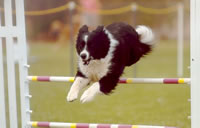
Photo by Ken Gee Photography |
The Old Spanish Trail Arena will be the site of three dog agility trials, sponsored by the North American Dog Agility Council (NADAC) dog agility trial in Moab, on April 17-19, April 24-26, and May 8-10, 2009. Competition begins at 9 a.m. each day. Dogs from all over the intermountain west, as well as several Moab canines, will be competing over timed, judged courses of jumps, ramps, tunnels and the ever-popular-with-spectators weave poles. Mixed breed as well as purebred competitors are judged on their speed, accuracy and safety as they zoom around a variety of courses, ten to twenty obstacles long. The two-legged member of each team is responsible for keeping the dogs on the correct courses (most four-leggeds haven’t learned to read the numbers!), as well as ensuring safe performance of each obstacle.
The North American Dog Agility Council (NADAC) is one of several organizations that sponsor agility competitions. NADAC was formed in 1993, to provide North American dogs and their handlers with a fast, safe and enjoyable form of the sport of dog agility. The purpose of a NADAC agility trial is to demonstrate the ability of a dog and its handler to work as a smoothly functioning team. With separate titling divisions for Veterans and Junior Handlers and a variety of games, NADAC agility offers something for everyone! Based in Oklahoma, NADAC sponsors competitions all over North America and Australia. The annual Championships will be held in Gillette, WY on September 23-27, 2009.
What obstacles are used?
· Jumps – Jumps are set at the proper height for each class, determined by the height of the dog at the withers (shoulders). Veteran dogs or those running with veteran handlers, junior handlers, and the Skilled class dogs can jump lower than their normal height. Dogs must clear the full height of the jump without knocking a bar off. Handlers sometimes run into the uprights and knock bars; that’s also a fault!
· Tunnels – An easy obstacle to train, many dogs suffer from “tunnel suck!”
· Contact Obstacles - The contact obstacles, so called because of the “contact zones” at lower end, include the A-frame and the dogwalk. To perform these obstacles correctly, the dog must get at least one paw in each contact zone when they descend the obstacle. The contact zone rule is for safety considerations.
· Weave Poles - The dog must enter to the right of the first pole and zig-zag through to the end. They must not miss a pole. If a dog “pops out” before the last pole, they must restart from the beginning.
How are runs judged?
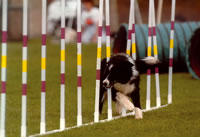
Photo by Ken Gee Photography |
Faults occur if the handler touches the dog or an obstacle while on course, or if the dog runs the wrong course, misses a contact zone, misses a weave pole or fails to complete the set, displaces a jump bar, or exceeds the amount of time set by the judge for running the course. Different classes allow different numbers of faults to be considered “qualifying.” A certain number of qualifying rounds will result in a title being earned.
Dogs are entered, depending upon their experience and previously-earned titles, at the Novice, Open or Elite level. There are special divisions for Veterans (dogs age 7 years or older, or handlers age 60 years or older) and Junior Handlers (age 17 or younger). In addition, NADAC offers the Proficient class, in which dogs must have no faults to qualify, and the Skilled class, in which dogs can have five faults (e.g., one knocked bar) or be up to five seconds over time and still qualify. In addition, dogs running in the Skilled class jump one height lower than their usual.
What events are offered?
· Regular Class requires that the dog, under the direction of the handler, perform all of the agility obstacles in the order and under the time limit set by the judge. There are usually two regular classes offered each day.
· Chances Class offers tests in direction, distance, and discrimination between two obstacles. There are 10 to 15 obstacles, and each level has one, two or three tests (Elite having all three). All dogs have 40 seconds to complete this class.
· Jumpers Class is composed only of jumps and tunnels, and can be fast and furious!
· Touch ‘n’ Go consists of the contact obstacles (A-frame and dog walk) and tunnels.
· Weavers consists of just weave poles and tunnels. Each level has a different number of poles, with either six or ten/twelve poles per set. Novice dogs will run three short sets, while Elite dogs see three long sets.
· Tunnelers –yep! You guessed it! –consists of just tunnels!
· Hoopers – a new class, where “ground speed obstacles” which look like hula-hoops on edge must be negotiated. The rules are rather complicated to explain – suffice to say, handlers can get easily confused, and most end up in hysterical laughter before the end! Hoops are now being used in some of the other classes as well.
Why Do People Do This?!
Agility is great for dogs and people for a number of reasons.
• It can build confidence in shy or nervous dogs. Once they figure out they can do the obstacles, they tend to love it!
• It provides a safe and fun outlet for a dog’s energy.
• It provides a competitive environment where a dog and handler can compete not against other dogs, but just against the course and themselves.
• It builds a strong and loving bond between dog and handler. Training should always be more fun than work, and trainers should always set it up so the dog is never wrong. Dogs respond much better to positive reinforcement, and it shows in their success.
What happens at an event?
When the course has been set up, the handlers gather together for a “judge’s briefing” where the judge summarizes how the class is judged. Then the handlers may “walk the course.” They do this as a group, without their dogs, following the numbers to become familiar with how the course goes. Most handlers try to walk the course as many times as they can in the time allotted, to plan their strategy. You may see handlers during a course walk actually running the course with an imaginary dog, giving the commands as they would during their competing round. Sometimes handlers gather in little groups and discuss challenges and how they are going to handle them.
The dogs run the course individually, in a pre-determined order, off leash and without collars (for safety reasons). The timer will tell the handler when he or she may begin, starting the stopwatch as soon as the dog crosses the start line and stopping it when the dog crosses the finish. As each dog runs, the judge indicates the faults, which are noted on a sheet of paper by the scribe. At the completion of the round, the scribe records the dog’s time. The information is then conveyed to the scorekeeper, who calculates the qualifying performances and top placements. These are usually then posted somewhere for competitors to see.
Spectators are welcome; non-entered dogs are discouraged from attending.
A few rules will keep everyone happy and healthy:
• Before you reach out to pet a dog, always ask the owner/handler FIRST. Please especially be sure your children observe this rule. Please supervise your children at all times.
• Feel free to sit or stand ringside and observe, but please remember to stay back a reasonable distance from the ring itself and especially stay away from ring entrances and exits.
• It is against the rules for spectators to assist or coach the handler/dog team by, for example, yelling out the correct obstacle order from the sidelines. (Yes, handlers do sometimes get confused or lost on course!) It is also not appropriate to shout the dog’s name, since this would distract the dog from the handler’s commands.
• But please feel free to applaud and cheer the dogs on, and show your appreciation at the END of a particularly good or entertaining run.
Several Moab dogs are entered in these trials. Come and cheer for them and all the others! |