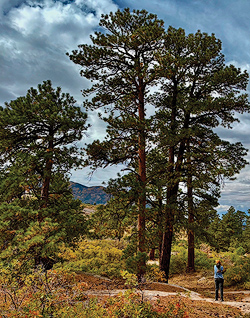
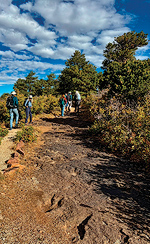
 Why would a group of Moab bird nerds be driving for an hour up into the Manti-La Sal National Forest to see theropod ichnites, fossilized dinosaur tracks? The connection between modern birds and this clade of dinosaurs is direct: birds evolved from small, feathered theropods during the Jurassic period. The only surviving lineage of dinosaurs, they eventually evolved into more than 11,000 species,. Modern birds are a type of theropod. “Thero” is a Greek word for feral or beastly, and “pod” means foot. These bipedal, mostly carnivorous dinos first appeared in the Late Triassic period, ranging from the crow-sized Microraptor to Tyrannosaurus rex, about the size of a John Deere 710L backhoe. Beast-foot dinos had three-toed, bird-like feet, hollow bones, and were saurischian (lizard-hipped), sharing additional features such as S-curved necks and feathers. Evolving gradually over millions of years, they adapted to habitats worldwide. The birders were here to see opposite ends of an avian family tree. Why would a group of Moab bird nerds be driving for an hour up into the Manti-La Sal National Forest to see theropod ichnites, fossilized dinosaur tracks? The connection between modern birds and this clade of dinosaurs is direct: birds evolved from small, feathered theropods during the Jurassic period. The only surviving lineage of dinosaurs, they eventually evolved into more than 11,000 species,. Modern birds are a type of theropod. “Thero” is a Greek word for feral or beastly, and “pod” means foot. These bipedal, mostly carnivorous dinos first appeared in the Late Triassic period, ranging from the crow-sized Microraptor to Tyrannosaurus rex, about the size of a John Deere 710L backhoe. Beast-foot dinos had three-toed, bird-like feet, hollow bones, and were saurischian (lizard-hipped), sharing additional features such as S-curved necks and feathers. Evolving gradually over millions of years, they adapted to habitats worldwide. The birders were here to see opposite ends of an avian family tree.
From Moab, we drove north on US 191 to the intersection with Utah State Route 128. We turned right/east and continued for 15.5 miles on 128, then turned right/east onto the La Sal Loop Road toward Castle Valley, continuing on for another 10.7 miles. Loop Road signs signaled a right turn/southwest, but we continued straight/east on this road (FR207) for 5.4 miles, a scenic serpentine drive amid mountainsides streaked with quaking aspen golds and piney greens. We pulled into the Overlook trailhead lot on the left/northeast, at 8,500 feet above sea level, more than double the Moab valley’s elevation. About ten motorcyclists in fancy touring rigs from Monticello and Blanding had also just arrived, happy there was a restroom after their windy approach and curious about this short (0.2 mile) interpretive trail.
I found myself imagining the great squish-squash-splish-splishy sucking sounds these dinos must have made as they tramped across our shallow coastal mud, the tropical tide-lands of an inland sea, over 165 million years ago. These lowlands were eventually uplifted to the Fisher Mesa overlook bird clubbers now stood on, 1,000 feet above the floor of Bull Canyon which drains into Fisher Valley to the north. The scrunchy, graveled trail has two sections: one through scrubby, just-turning Gambel oaks and robust Ponderosa pines, another along sand and slick rock to and along the overlook. We walked beside the lithified tracks which measured about two to three inches deep and about eight inches long. Photographing or sketching the tracks is allowed, but visitors may not make rubbings, tracings, molds, or casts of these prints preserved in late Jurassic Entrada Sandstone. Other track sites in the Moab area include those at Willow Springs, Copper Ridge, Mill Canyon, Poison Spider, and Dinosaur Stomping Grounds in the Klondike Bluffs area. These tracks can be especially striking and well-defined when filled from our monsoon rains. Please note there are other Bull Canyon Trails in Utah: one accessed out of Thompson Springs, an ATV trail reached from Gemini Bridges Road, and another in Dinosaur National Park.
On this brilliant, bluebird morning, the birders were at this overlook primarily to glass migrating raptors catching thermals rising up from the canyon. We saw golden eagles, sharp-shinned and Cooper’s hawks, and American kestrels; plus forest-dwelling warblers, mountain chickadees, sapsuckers, swifts, flickers, jays, nuthatches, bluebirds, and some curious ravens. (A special thanks to Mary Moran for doing the tallying.) We trained our binoculars on these living birds flitting among the Ponderosas and those wheeling above the canyon on spiraling air currents, their super-great-grandparents’ petrified tracks behind us. The buzzy dee-dee-dees of concealed chickadees serenaded our lunchtime on the rocks and the eventual reluctant walk back amid the fragrant detritus of pinecones and pine needles to cars and responsibilities..
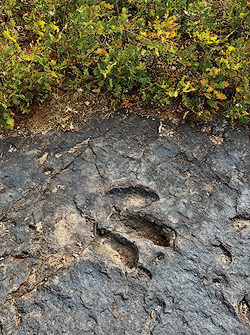 A theropod footprint
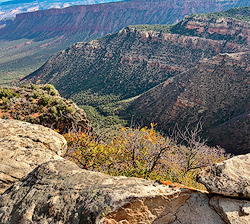 Bull Canyon
-sharpened.jpg) Kathy Grossman Kathy Grossman is a birder, nature journalist, and writer who lives between Moab’s Pack and Mill Creeks. She recommends the Forest Service YouTube video “Bull Canyon Dinosaur Track Trail and Overlook” where Brian Murdock extolls the area’s woodland beauty and paleontology.
|