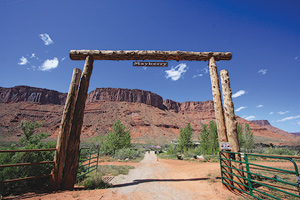
 As you read this, we are on the brink of Earth Day 2025. Hold on to that thought, for here in Moab, there are plans afoot, involving a venerated thirty-acre site several miles outside of town known as the Mayberry Native Plant Propagation Center. As you read this, we are on the brink of Earth Day 2025. Hold on to that thought, for here in Moab, there are plans afoot, involving a venerated thirty-acre site several miles outside of town known as the Mayberry Native Plant Propagation Center.
According to the historical record, the first Earth Day, April 22, 1970, was designed to usher in “the dawn of the modern environmental movement” and college student-wise was timed to fall between Spring Break and final exams. Deemed the “largest secular day of protest in the world,” the event’s inception stopped the traffic on Fifth Avenue and drew students and people like me to places like New York’s Central Park and literally everywhere in the country.
For those who weren’t around in 1970, it was engaging, spirited, hopeful and electrifying and it made history happen.
I’m talking with Kara Dohrenwend, the energetic executive director and founder of Moab’s nonprofit Rim to Rim Restoration, about the upcoming Earth Day celebration at Mayberry.
Dedicated to the sustenance, restoration, and improvement of plant life throughout the giant high desert realm known as the “Colorado Plateau”, Rim to Rim Restoration has plenty going on even without planning an Earth Day celebration.
But just now, as per that celebration, Dohrenwend is focusing on something rather small – the miracle of bringing out of the ground new plants by sowing seeds. Plants that will enrich the local habitat and be sustainable here in the high desert.
“It’s fundamental,” she says, “working with seeds, getting plants to grow. And it needs to happen all over the place.”
She talks about transferring seed from place to place to determine how far seeds can travel and still survive.
She talks about the connections of Rim to Rim with Federal agencies like the National Park Service, the U.S. Forest Service and the Bureau of Land Management (BLM), agencies she says are not just about law enforcement and recreation: “There’s a lot of restoration and a lot of reasons why this restoration has to happen.”
Dohrenwend, who holds a degree in landscape architecture from the University of California at Berkeley, started Rim to Rim in 2007 following a decade leading summer work projects in Mill Creek Canyon that engaged local youth with hands-on riparian restoration.
By 2009, Rim to Rim had acquired the Mayberry site from the Nature Conservancy. The vision then, as now, was to create a native plant propagation center and align with a BLM program called “Seeds of Success” that encourages and supports ventures like Mayberry.
As this article goes to print, the future of Rim to Rim’s Federal funding is uncertain. “We have no idea what will happen,” Dohrenwend says. The Federal agencies have traditionally offered up five-year obligations, and the long-term perspective, according to Dohrenwend, is “so important—plants take a long time to grow and some planted as seedlings in 2014 are just now producing enough seed to collect regularly.”
What better moment to celebrate Earth Day and what better place to celebrate it than the venue that has held the celebration for the last ten years or so, with the exception of a couple of seasons during the pandemic -
This year’s focus, Dohrenwend says, will be on the Federal public lands partners in appreciation for what they have contributed to the Mayberry project, specifically, and—more broadly—their collaborations with Rim to Rim.
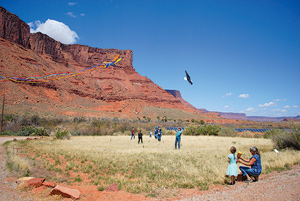
The celebration will feature music, light snacks, a small planting event, a traditional kite-flying (bring your own kites), a self-guided tour, and an opportunity to learn the ins and outs of all things having to do with a common garden and that small intrepid warrior known as “the seed.”
The Earth Day event is free and will actually be held on Saturday, April 26 from 1-4 p.m. To get there: North on 191, right onto 128 (“the river road”) and watch for Mayberry on the left 15 miles upriver.
And for more info on Mayberry: www.revegetation.org/mayberry/
And be sure to mention you read about it in Moab Happenings.
|
/tr>

