 Lizards and snakes are well suited for desert living here in Canyon Country. These cold-blooded creatures, better known as ectotherms, utilize heat from their environment to warm their bodies, unlike warm-blooded creatures, or endotherms, that generate body heat internally. This thermoregulation strategy has been around for millions of years and has allowed snakes, lizards, and turtles (crocodiles, too) to inhabit a wide variety of environments.
As temperatures warm up in June, many canyon-dwelling wildlife species avoid the mid-day heat by changing their activity patterns to the cooler hours in the morning and evening. They hole up during the hottest portions of the day to avoid using excess amounts of metabolic moisture, a premium here in the desert. Hence, the only wildlife you may encounter during the day are reptiles, birds, and other species spooked from their hiding places.
Let’s start with lizards because they are iconic desert dwellers and they get more love than snakes, their reptilian relatives.
 A reptile’s skin is covered with scales for protection from the environment and to help them reduce moisture loss, and they can employ other strategies to thermoregulate. Mainly, this involves finding warmth where and when they need it to get their bodies moving, but also to seek shade when temperatures rise above a comfortable level. In addition, a lizard’s three-chambered heart, though not the most advanced, efficiently and simply circulates blood through the body. During inactive periods, the heart can pump deoxygenated blood to the body, bypassing the lungs which requires energy.
Lizards, such as the side-blotched or ornate tree lizard, have a small body mass which doesn’t require a lot of warm up time to get themselves moving. The side-blotched is named for the dark patch behind the foreleg and the tree lizard’s ornate colors and patterns give it its common name. Both of these lizards feed on adult and larval insects, and side-blotched lizards are known to prey on scorpions, as well.
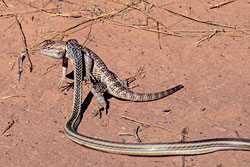
These smaller lizards may fall prey to larger lizards such as the desert spiny, leopard or collared lizard, as well as other predators such as American kestrels or the greater roadrunner which seems to be expanding its range into Utah and Colorado.
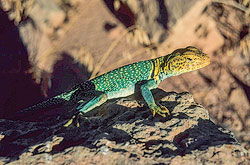
Of all the area lizards, the collared lizard probably gets the most accolades. Striking in coloration with a blue-greenish colored body dotted with yellow, white or orange spots; a yellowish head; and prominent dark neck bands, the collared lizard is a sight to behold. Averaging 14 inches long, these lizards may be seen sunning on some rocky outcrop where they can survey their domain. Quick and agile, these lizards may even run on their hind legs, called bipedal motion, and resemble some ancestral dinosaur that once roamed this land.
Whereas lizards often elicit delight by the viewer, their sinuous relatives, the snakes, do not. This is unfortunate because snakes are just as intriguing as the lizards.
Here in the desert landscape of southern Utah, the midget faded rattlesnake is the predominant pit viper. This subspecies of the western rattlesnake is generally less than 3o inches long and tannish in color. A shy and reclusive rattler, these snakes may be easily overlooked by hikers. When alarmed, the snake vibrates the buttons on its tail which creates an internationally-recognized warning sound.
These rattlers use their venom to paralyze prey such as small rodents. Occasionally, a dog or human gets bitten as well and may lead to a serious reaction, although not all snake bites involve envenomation.
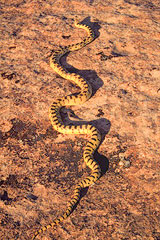
Of all the other snakes that occur in southern Utah such as racers, whipsnakes, and garter snakes, one commonly observed species is the Great Basin gopher snake. Ranging from 3 to 6 feet in length, this nonpoisonous snake subdues its prey through constriction or by grasping a small rodent or nestling bird and swallowing it whole. These snakes may vibrate their tail to mimic a rattlesnake and warn away predators, but hawks and kit foxes may not be fooled by this action.
So, as you venture out into the Canyonlands this June, keep an eye for these interesting reptilian relatives and give them some space to do their thing.

 A natural history writer.