Life in Order:
Fossils, Faunal Succession, and Moab by Allyson Mathis
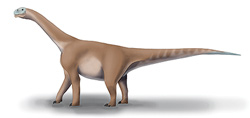
Reconstruction of Moabosaurus. Credit: Audrey.m.horn, CC BY-SA 4.0
Southeastern Utah contains a tremendous fossil record. The area is best known for its dinosaurs, including several species identified from fossils found here, including Moabosaurus and Gastonia. Moabosaurus is a type of sauropod, the familiar type of long-necked plant-eating dinosaurs that stood on four legs.
Moabosaurus was a stout sauropod that reached lengths of around 32 feet. It lived in the Early Cretaceous Period, which came after the Jurassic. The Jurassic was populated with many familiar dinosaurs including Diplodocus, Camarasaurus, and Allosaurus, the Utah state fossil. Many specimens of these dinosaurs have been recovered from Jurassic National Monument near Price and Dinosaur National Monument north of Vernal, although fossils of some of these dinosaurs may be seen along the Mill Canyon Dinosaur Bone Trail near Moab.
Moabosaurus was described from 125-million-year-old fossils collected in the Dalton Wells Quarry, which is now in Utahraptor State Park. Utahraptor State Park, Utah’s newest state park having officially opened in 2025, was named for another dinosaur found in that same quarry.
Moabosaurus lived after the Jurassic heyday of the sauropods. Although all sauropods share some common characteristics, Moabosaurus was distinct from common Jurassic sauropods, like Diplodocus and Camarasaurus.
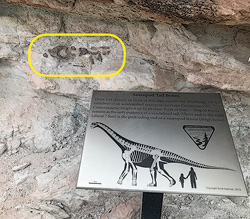
Camarasaurus tail vertebrae on the Mill Canyon Dinosaur Bone Trail.
The presence of fossils of these and other dinosaurs in the Moab area, plus the many other types of fossils found here, makes canyon country a great place to learn about paleontology (the study of ancient life). Like the other natural sciences, paleontology is guided by a number of principles (descriptions of the natural world). Principles are predictive about what will be observed in nature. For example, the principle of uniformitarianism (the present is key to the past) is probably the most well-known principle that guides geologists.
The principle of faunal succession says that the sequence of organisms found in the fossil record has a predictable order through geologic time, with groups of organisms succeeding others in a specific order. This pattern was first recognized by William “Strata” Smith (1769–1839), a surveyor in England whose work led to the world’s first geologic map. Faunal succession was used by Darwin as evidence to support the theory of evolution.
In addition to dinosaurs, other fossils found near Moab include petrified wood, other plant fossils, reptiles, and marine invertebrate fossils such as brachiopods, crinoids, and mollusks.
Some of this fossil diversity comes from the variety of environments that the sediments that later became the rock layers (formations to geologists) exposed throughout canyon country were deposited in. Fossils of animals that lived on land like dinosaurs are found in layers that were deposited in terrestrial environments like river basins and along shorelines, and marine fossils are only found in layers deposited during time intervals that this area was flooded by inland seas.
The rocks exposed throughout southeastern Utah were mostly deposited between about 310 and 70 million years ago. According to the Geologic Time Scale, these rocks range in age from the late Paleozoic Era (“ancient life”) through the Mesozoic Era (“middle life,” otherwise known as the “age of the dinosaurs”). Reconstruction of Moabosaurus. Credit: Audrey.m.horn, CC BY-SA 4.0
Many extinctions also occurred during this time interval. The largest extinction in geologic history occurred at the end of the Paleozoic, when most groups of animals that lived in the oceans became extinct and life on land was also completely transformed. Other extinctions took place during the Mesozoic (including at both the end of the Triassic and Jurassic) prior to the big extinction at the Mesozoic Era when dinosaurs died out.
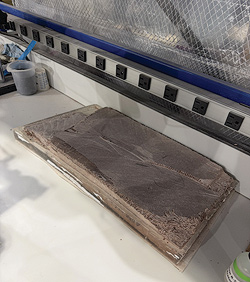
Most of the late Paleozoic rocks found in southeastern Utah were deposited in ocean environments, so most of the fossils of this age found near Moab are of marine invertebrates. However, a fossil of an early reptile relative (a reptiliomorph) was collected in Canyonlands National Park a few years ago. National Park Service paleontologists are still working on removing the rock matrix from around the specimen so they can study of this early land-dwelling tetrapod.
The Mesozoic fossil record from the Moab area also shows faunal succession. The oldest Mesozoic rock layers here, the Moenkopi and Chinle Formations, do not contain dinosaur fossils since dinosaurs were not prevalent then. However, these layers contain fossils of other reptiles and amphibians.
The Jurassic Morrison Formation contains a distinctive dinosaurian fauna that is different from the younger (Cretaceous) Cedar Mountain Formation. About 10 million years separates the Morrison from the oldest sections of the Cedar Mountain Formation.
Altogether, the Cedar Mountain Formation is one of the most important dinosaur-bearing rock layers in all of North America. First, rocks of Early Cretaceous age are rare on this continent. Also, the layer spans a long period of time and it contains six distinct dinosaur faunas with more than 30 types of dinosaurs identified from this unit. Some of this dinosaurian diversity results from changing climate and global sea level as well as movement of the landmass through plate tectonics.
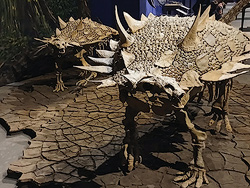
Two mounted Gastonia fossils. Gastonia was a type of armored herbivorious dinosaur in the ankylosaurs group that lived during the Cretaceous. Credit: A Cynical Idealist, CC BY-SA 4.0
A self-described “rock nerd,” Allyson Mathis is a geologist, informal geoscience educator and science writer living in Moab.
To learn more about Moab’s geology, visit the Geology Happenings archive online at https://www.moabhappenings.com/Archives/000archiveindex.htm#geology
 A self-described “rock nerd,” Allyson Mathis is a geologist, informal geoscience educator and science writer living in Moab.